



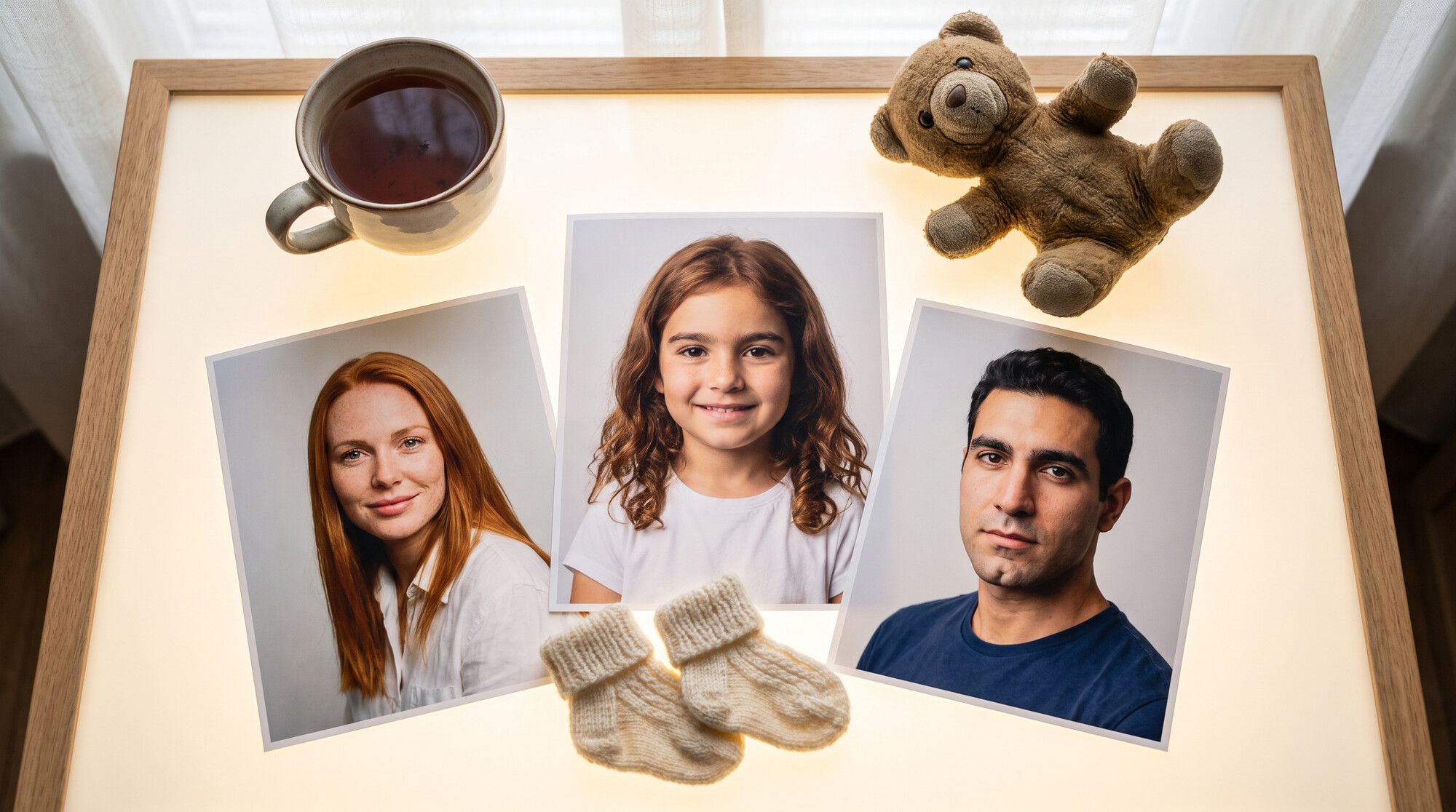
Almost every couple wants to know who their child will take after. AI can’t see the future, but it can draw a plausible portrait that shows traits from both parents. We tested this in the AI2Face generator on a fictional couple with deliberately contrasting looks, so it’s clear which traits the model takes from the mother and which from the father.
How to use a future baby generator
- Upload two portraits as references: the first is the mother, the second is the father. Say that order in the prompt.
- Set the age and the sex: “a daughter around 6”, “a baby around 1”.
- Ask it to blend the traits and list which ones: eyes, eyebrows, freckles, lips, hair. Without that, the model often copies one parent.
- Add “a plausible real child”: otherwise a baby sometimes ends up with an adult face.
Our “parents”: a red-haired woman with green eyes and freckles, and a dark-haired man with brown eyes, thick eyebrows, and a dimple on his chin.
A prompt for a child from the parents’ photos
Using the two reference photos as the mother (first photo) and the father
(second photo), create a realistic portrait photo of their daughter at about
6 years old who naturally combines features of both parents: mixed traits such
as the father's dark brown eyes and thick eyebrows with the mother's freckles,
nose and lips, wavy auburn-brown hair, skin tone between the parents. Head and
shoulders, white t-shirt, plain light grey background, soft studio light,
natural smile. A plausible real child.
You can write the prompt in plain English, but keep “first photo — mother, second photo — father”: that way the model won’t mix up whose traits to take.
A future baby at one year
For a baby, name the traits more loosely (“for example…”): at one year the face still doesn’t look much like an adult’s, and strict requirements produce a little adult.
Daughter or son: what the child looks like at 6
We asked for the father’s eyes and eyebrows on the daughter, and the mother’s eyes on the son. The model followed both requests and added guesses of its own: the son got freckles, and the daughter got wavy auburn-brown hair.
Generation isn’t a lottery: the model almost always takes the traits you named. It’s more interesting to make 3–4 versions with different mixes (“mom’s eyes, dad’s hair”, and the reverse) than one “exact” portrait.
Nano Banana Pro or GPT Image 2.5
We sent the daughter’s prompt to Nano Banana Pro and GPT Image 2.5:
| Nano Banana Pro | GPT Image 2.5 | |
|---|---|---|
| Dad’s traits | eyes, eyebrows, skin tone | barely visible |
| Mom’s traits | freckles, lips, a red tint in the hair | hair, freckles, light eyes |
| Follows the prompt | exactly | partly: didn’t take the brown eyes |
| Realism | high | high |
On our test, Nano Banana Pro is better at “blend the traits” — the child really does look like both parents. GPT Image 2.5 produced a child who’s the spitting image of the mother. If you also get a copy of one parent, list the other parent’s traits explicitly and generate again.
A family photo with a future child
The warmest format is a group photo where the parents stay recognizable and the child sits on the mother’s lap.
For a shot like this, add “Keep both parents’ faces exactly recognisable”. For more scenes with several people in the frame, see an AI family photoshoot and multiple characters in one image.
How close this is to the truth
An image model doesn’t model inheritance. It sees two faces and draws a third that carries their traits — the same way an artist would draw “this couple’s child”. Genetics is more complicated:
- Several genes set eye color. According to MedlinePlus (the U.S. National Library of Medicine), OCA2 and HERC2 play the main role, but there are at least eight more genes with a smaller contribution.
- The outcome isn’t always predictable. The same source says blue-eyed parents can have a brown-eyed child, though it’s rare. The simple school scheme “brown dominates” doesn’t explain this.
So treat the portrait as a postcard or a game: it shows one plausible option, not that specific child.
Which photos of the parents to upload
- Front-facing, face large. A profile or a three-quarter view tells you less about the features.
- Even daylight in both photos. A warm lamp in one shot “recolors” skin and hair.
- No glasses, filters, or heavy makeup. The model carries them over to the child as a trait.
- A similar background and crop. Then it’s easier for the model to compare the faces. Improve small or dark shots first with an AI photo enhancer.
What to do with the result
- A series by age. Upload a successful portrait of the child as a reference and change only the age: you get the same person at 1, 6, and 16.
- Twins. Ask for “twins, a boy and a girl” — the model draws two similar children with different mixes of traits.
- Bring the portrait to life. A short video of the baby smiling and waving is made from the finished frame — see how to animate a photo.
Where to use a future baby generator
In AI2Face, Nano Banana Pro and GPT Image 2.5 sit in one generator: upload two portraits, send the prompt to both models, and pick the child who looks more like both parents. The cost of each generation is shown before you start, you can pay by card or crypto, and credits from packs don’t expire. Use your own photos, or your partner’s with their consent.
Bottom line
A future child from the parents’ photos isn’t a forecast. It’s a plausible blended portrait: the model takes the traits you named and fills in the rest. For a child who looks like both parents, upload two even, front-facing portraits, say who is the mother and who is the father, and list each person’s traits. On our test, Nano Banana Pro handled this better, while GPT Image 2.5 more often draws a copy of one parent. Make several versions and a family photo — it’s a warm gift for a couple, not a medical answer.
FAQ
How can I see what a child will look like from the parents' photos?
Upload one portrait each of the mother and the father and ask the generator for a photo of their child at the age you want, combining traits of both. Nano Banana Pro makes that portrait in about half a minute.
How accurately does AI predict a child's appearance?
It doesn't predict it at all. The model draws a plausible blend of the two faces. It doesn't calculate inheritance: even eye color depends on several genes, and blue-eyed parents can have a brown-eyed child.
Can I see the child at different ages?
Yes. Put the age in the prompt — “about 1”, “6”, “16”. To get the same child at different ages, upload the finished portrait as a reference and change only the age.
Which photos of the parents should I upload?
Front-facing portraits in even daylight, no glasses, filters, or heavy makeup, with the face large. Both photos should be in similar light, or the model mixes up skin and hair color.
Can I make a photo of a future baby for free?
Yes, a few versions. AI2Face gives you welcome credits after you sign up, and the cost of each generation is shown before you start.
Sources
4
- https://medlineplus.gov/genetics/understanding/traits/eyecolor/
- https://blog.google/innovation-and-ai/products/nano-banana-pro/
- https://ai.google.dev/gemini-api/docs/image-generation
- https://developers.openai.com/api/docs/models/gpt-image-2.5-sunburst