








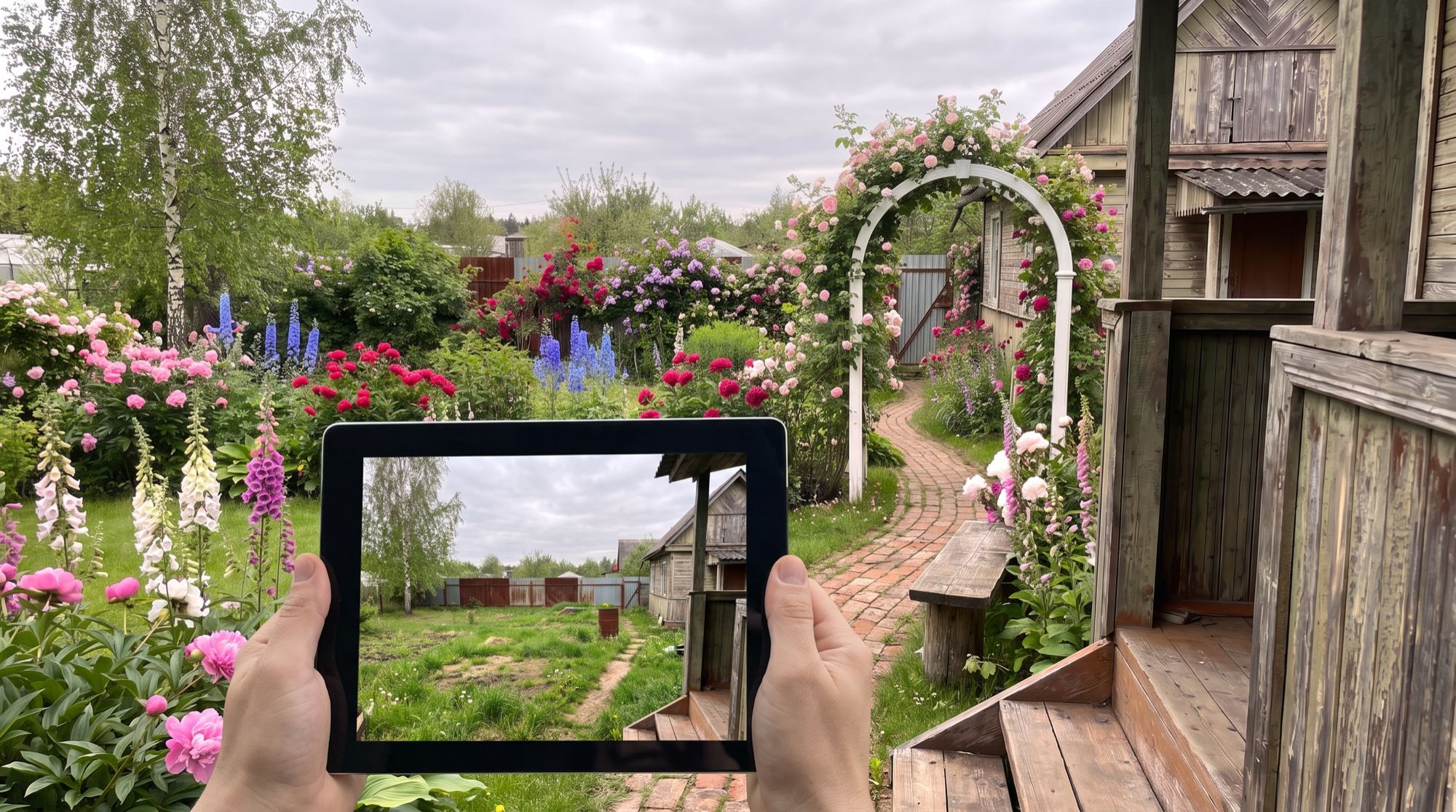
AI landscape design shows what a yard will look like before you buy the first bag of gravel. You photograph the yard, describe a style and get a photorealistic version of the same place: your house, your trees and the neighbors behind the fence. We tested this on a neglected country garden plot in a cold temperate climate (central Russia in our test). Every image below was made in the AI2Face generator.
What AI landscape design can do
| Task | Input | Output |
|---|---|---|
| Redesign from a photo | a photo of the plot | the same plot in a new style |
| Targeted edit | a photo of the plot | a new path, gazebo or flower bed; the rest unchanged |
| Plan visualization | a sketch or a site plan | a 3D view from above |
| Lighting and season | a finished version | the same garden in the evening, in autumn or in winter |
| Concept from scratch | a text description | a garden that doesn’t exist yet |
You don’t need a separate garden app for this. Nano Banana Pro handles these tasks the same way as AI interior design: it keeps what you list and redraws the rest.
Which photo of the plot to take
We generated a typical “before”: a patchy overgrown lawn, a trodden path, a rusty barrel, an old corrugated metal sheet fence, a birch in the corner and the porch of a wooden house.
Rules for your own photo:
- Shoot from the porch or a corner of the house, at eye level. The frame should include the boundary of the plot and whatever you want to keep.
- An overcast day, or shade. Hard shadows from trees get carried into the new garden and read as paths.
- More ground in the frame than sky. The model works with what it sees.
- No need to clear the junk. The barrel and the weeds go if you write “remove the barrel and weeds.”
- Shoot in season. A summer photo gives a believable result for a summer garden.
A prompt for AI landscape design from a photo
The formula: style + path surface + lawn + 3–5 plants + garden structures + what to remove + what to keep. The last part is essential. Without it the model may rebuild the house or cut down the birch.
Redesign the garden in this photo in a modern minimalist style: an even lawn of
rolled turf, a straight path of large light-grey concrete slabs with gravel joints
from the porch to the back of the plot, a low raised bed of corten steel with
ornamental grasses and lavender along the fence, a few young pines, low bollard
lights, and replace the old corrugated metal sheet fence with a neat dark-grey
fence of horizontal wooden slats, the same height. Remove the barrel and the weeds.
Keep exactly as in the photo: the house and the porch on the right, the birch in
the left corner, the size of the plot, the neighboring houses behind the fence,
the overcast light and the same camera angle. Photorealistic, no people, no text.
Name the plants. “Pretty shrubs” turn into random southern plants. “Arborvitae (Thuja), panicle hydrangea, spirea (Spiraea)” give you a garden that can survive a cold winter.
One plot in 4 styles
All four versions come from the same source photo. Only the first part of the prompt changes — style, materials and plants. The “what to keep” line stays the same.
Modern minimalism
English cottage garden
Redesign the garden in an English cottage style: lush mixed borders of roses,
delphiniums, foxgloves, peonies and hostas along the fence, a curving path of old
red brick from the porch, a white wooden arch with climbing roses, a small wooden
bench, a soft lawn, the old fence hidden behind shrubs and climbers.
A Japanese garden for a cold climate
Redesign the garden in a Japanese style adapted to a cold temperate climate: pale
gravel, flat stepping stones from the porch, a few large boulders, moss and low
ferns, a stone lantern, mountain pines and junipers shaped as niwaki, one Japanese
maple, a low bamboo screen fence. No palm trees, no tropical plants.
A barbecue seating area
Turn the plot into a family seating area: a wooden deck by the porch with a table
and chairs, a brick barbecue with a work counter, a wooden pergola with string
lights over the deck, an even lawn, a path of WPC (composite) decking toward the
back, hydrangea and spirea shrubs, arborvitae along the fence, and replace the old
corrugated metal sheet fence with a dark-brown picket fence.
| Style | Prompt keywords |
|---|---|
| Minimalism | rolled turf, concrete slabs, gravel, corten steel, ornamental grasses, lavender, pines |
| Cottage garden | mixed border, roses, peonies, delphinium, brick path, arch, bench |
| Japanese | gravel, stepping stones, boulders, moss, fern, lantern, niwaki pine, maple |
| Seating area | deck, pergola, barbecue, string lights, WPC decking, hydrangea, spirea, arborvitae |
| Kitchen garden | raised beds, greenhouse, fruit trees, plank paths, compost bin |
A landscape from a site plan
If the plot is empty, or you have already sketched the zones on paper, start with a plan. We drew a simple sketch: beds on the left, a lawn in the center, a gazebo with a pond in the far corner, a patio by the house.
Turn this hand-drawn landscape plan into a photorealistic 3D view of the same
garden from above, at a 45-degree angle. Keep the layout exactly: raised beds on
the left, a rectangular lawn in the center, a row of shrubs and trees along the
back fence, a curved stone path to a round wooden gazebo in the far right corner,
a small round pond by the gazebo, a patio with a round table by the house.
Cold-hardy plants, a wooden fence, summer daylight. No text, no labels.
The zones, the path and the gazebo match the sketch. The model invented the proportions of the house. Dimensions on a visualization like this are approximate: it is useful for agreeing on the zones, not for staking out the plot.
Evening lighting in the garden
Lighting is the hardest thing to picture ahead of time. Take a finished version and ask to see it in the evening. The model places the lights and keeps the layout.
Show this same garden on a warm summer evening at blue hour: the string lights on
the pergola are on, a soft fire in the brick barbecue, small warm spotlights under
the arborvitae and the hydrangeas, low lights along the path, a deep blue sky with
a little sunset left. Keep the layout, the house, the porch, the birch, the fence
and the camera angle as in the photo.
You can check autumn or winter the same way: “show this garden in October,” “under snow.” That shows whether the plot will look empty for half the year, and whether to add evergreens.
Limitations of AI landscape design
- Placement is approximate. In the barbecue version the model put the terrace at the back of the plot, even though the prompt asked for it by the porch. Compare the result with the prompt and ask again.
- Scale is approximate. The model doesn’t know the size of the plot. A gazebo can come out smaller than the real one, and a path narrower than a meter.
- The plants look right. They don’t grow. The model doesn’t check hardiness zone, light or soil pH. Check each plant in a nursery catalog.
- Engineering is left out. Slopes, drainage, frost depth under a gazebo foundation and power to the lights are for a designer.
- The default season is summer. In spring and autumn the garden looks different. Ask for seasonal versions on their own.
Where to do AI landscape design
Nano Banana Pro is in the AI2Face generator. Upload a photo of the plot or a sketch, paste a prompt from this article and compare several styles. Send a version you like into the next generation to see it in the evening or in another season. The cost of each generation is shown before you start, you can pay by card or crypto, and credits from packs don’t expire. For an overview of models for any kind of image, see our guide to the AI image generator.
Bottom line
AI landscape design delivers in an evening what used to take weeks of collecting reference pictures. In our test, one neglected country garden plot in a cold temperate climate (central Russia in our test) became four different gardens, while the house, the porch and the birch stayed put. For a redesign from a photo, use Nano Banana Pro with “keep the house, the trees and the camera angle as in the photo,” and name cold-hardy plants outright. For zoning, start with a sketch and turn it into 3D. This is a visualization: it helps you pick a style and agree with your family, while slopes, drainage and the plant list are for a landscape designer to check.
FAQ
How do I design a landscape from a photo?
Photograph the plot from the porch at eye level on an overcast day, upload the photo to the generator and describe the style: path surface, lawn, 3–5 plants and the garden structures. Add “keep the house, the trees and the camera angle as in the photo” — Nano Banana Pro redraws the plot in about half a minute.
How do I keep the house and the fence in the photo?
List everything that must stay: the house, the porch, a specific tree, the neighbors' buildings and the camera angle. In our test, with that line, the house and the birch stayed in all four styles. The model changes the fence only if you ask it to.
Why does the model draw palm trees and tropical plants?
Because the training data is full of southern gardens. Name cold-hardy plants outright — arborvitae (Thuja), mountain pine (Pinus mugo), hydrangea, spirea (Spiraea) — and add “no palm trees, no tropical plants.”
Can I try AI landscape design for free?
Yes, for a few versions. AI2Face gives you welcome credits after you sign up, and one plot version in Nano Banana Pro is inexpensive — the price is shown before you start.
Will AI replace a landscape designer?
No. It shows a look and helps you choose a style, but it doesn't calculate slopes, drainage, light or whether the plants can grow together. A working project with a planting plan is for a specialist.
Sources
2
- https://blog.google/innovation-and-ai/products/nano-banana-pro/
- https://ai.google.dev/gemini-api/docs/image-generation