








A family coat of arms is a classic school project and a fun family activity: kids draw one in elementary and middle school, and families use one on reunion T-shirts or a family-tree poster. The questions are always the same: what to draw, which colors to pick, how to describe it and what motto to write. Below are the rules of real heraldry, simplified for a school project, plus examples and a way to make the crest with AI if drawing takes too long or you want a polished version for a presentation. Every image was made in the AI2Face generator with Nano Banana Pro.
The parts of a family coat of arms
| Part | What it is | Required? |
|---|---|---|
| Shield | the base of the arms; everything important goes on it | yes |
| Field | the shield’s background, can be divided into parts | yes |
| Charges | images on the shield: a house, a tree, an animal, an object | yes, at least one |
| Helmet and mantling | the helmet above the shield and the leafy cloth around it | no, decoration |
| Supporters, branches | animals or branches on either side of the shield | no |
| Motto ribbon | a short phrase below the shield | usually yes for a school crest |
The Heraldic Council under the President of Russia calls the shield the basis of a coat of arms and doesn’t fix its shape. For a school drawing any shape works: pointed, rounded at the bottom, square.
Colors on a coat of arms: the rule of tincture
Heraldry uses just seven main colors, split into two groups:
| Group | Colors |
|---|---|
| Metals | gold (or, shown as yellow) and silver (argent, shown as white) |
| Colors | blue (azure), red (gules), green (vert), black (sable), purple (purpure) |
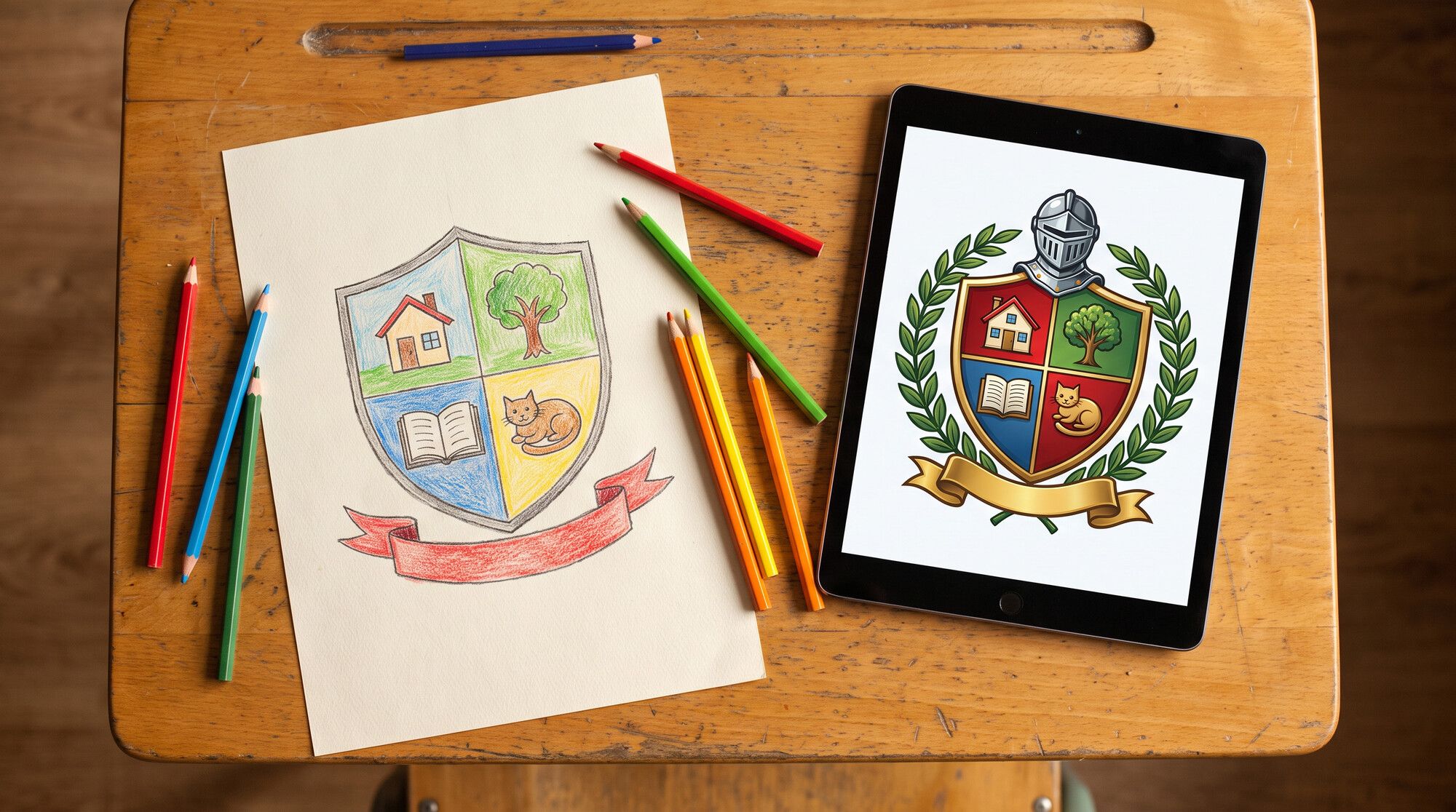
The key rule, which the Heraldic Council calls the basic rule of heraldry: don’t put metal on metal or color on color. A gold charge goes on a blue, red or green field, and a red charge goes on gold or silver. That’s what makes a coat of arms readable from a distance. The classic example above follows the rule in all four quarters: a gold book on blue, a silver house on red, a gold oak on green, a black cat on gold.
Colors have no fixed meanings: the Council’s guidelines say plainly that colors and charges carry no assigned meanings and that the correct interpretation is the one the designer gives. So the meaning is yours to choose — for example:
| Color | A meaning you could give it |
|---|---|
| Gold | abundance, generosity, a sunny family spirit |
| Silver | honesty, purity, home |
| Blue | loyalty, sky and sea, a family that loves to travel |
| Red | courage, love, energy |
| Green | nature, the garden, hope |
| Black | strength, craftsmanship, reliability |
Family crest ideas: what to put on it
The Council advises against trying to express everything in one coat of arms: one strong feature is better than a list. Two to four charges are enough for a family — one per part of the shield.
| What to say | Charge |
|---|---|
| Home, warmth, family | a house, a hearth, a nest, a beehive |
| Learning | an open book, an owl, a quill |
| A profession | a hammer and anvil, a gear, a medical cross, a brush, a steering wheel |
| Sports, hobbies | a ball, skis, a lyre or a note, a palette |
| Nature, the garden | a tree, wheat, a flower, an apple |
| A pet | a cat, a dog, a horse |
| Hometown | a river, a mountain, a symbol from the town’s arms |
| Strength, courage | a lion, a bear, an eagle |
The motto
A motto is a short phrase about what matters most to the family: “Together we are strong”, “Friendship and hard work”, “All for one”, “Knowledge is power”. Write it on a ribbon below the shield. Inscriptions don’t go inside the shield: the Heraldic Council’s rules call them inadmissible in a coat of arms, while a ribbon below the shield is the usual place for a motto.
A family crest for a school project
For school, a crest is usually drawn in colored pencils: a shield in four parts with a picture about the family in each, a sun or crown on top and a motto ribbon below.
To make drawing easier, print a template: an empty four-part shield, a helmet, branches and a ribbon.
How to describe a family coat of arms
Schools usually ask for a description with the drawing. In heraldry you first describe how the arms look, then what they mean. A sample for the classic crest above:
A shield divided into four quarters: in the first, blue, a gold open book; in the second, red, a silver house; in the third, green, a gold oak tree; in the fourth, gold, a black cat sitting. Above the shield, a silver knight’s helmet with blue and gold mantling; on either side, laurel branches; below, a ribbon with the motto “Together we are strong”.
The book means our family loves to read and learn. The house stands for our home. The oak stands for the strength and long lives of our grandparents. The cat is our pet, Oliver. Gold is our friendship, blue our loyalty, green our love of the garden.
Swap in your own charges and meanings — the structure stays the same.
A coat of arms based on your surname
Heralds have a name for arms whose charges hint at the family name: canting arms. A smith might get a hammer and anvil, a Fisher a fish, a Baker a wheatsheaf.
An important caveat: there’s no such thing as a ready-made “coat of arms for a surname”. England’s College of Arms answers this question directly: arms are granted to a specific person and their descendants, not to everyone with the same surname. People with the same surname often have entirely different arms, or none at all. Sites that “find your surname’s coat of arms” are selling a picture, not your family history. Your family designs its own crest.
AI coat of arms maker: how to make a crest with AI
If drawing takes too long or you need a clean version for a presentation, describe the crest to an AI model. For crests with a motto ribbon, Nano Banana Pro works well — it renders text accurately. The prompt for the classic crest:
Classic heraldic family coat of arms illustration, centered on a plain light
parchment background: a heater-shaped shield quartered — top left blue field
with a golden open book, top right red field with a silver house, bottom
left green field with a golden oak tree, bottom right golden field with a
black cat sitting. A silver knight's helmet on top with blue and gold
mantling, two laurel branches around the shield, and below the shield a
flowing white ribbon with the motto in elegant dark capital letters:
TOGETHER WE ARE STRONG. Write the motto exactly, without quotation marks.
Crisp detailed vector-like heraldic art, no other text, no logos.
How to write your own prompt:
- Shield and division: “a shield quartered” (four parts), “divided in half vertically” (two).
- Each part: the field color and the charge — “blue field with a golden open book”.
- Decorations: a helmet, a crown, branches, animals at the sides.
- Motto: the ribbon text without quotation marks, plus the line “Write the motto exactly”.
- Style: “heraldic illustration” for a polished crest, or “child’s colored-pencil drawing on A4 paper” for a school drawing.
Every caption in our examples — the mottos, the surname, the title on the school sheet — came out without errors on the first try, in English and in Cyrillic. Still, reread long mottos before printing. If you need the crest as an emblem for T-shirts or mugs, see our AI logo generator guide.
Bottom line
A family coat of arms comes down to a shield, two to four charges about the family, two to four colors that follow the rule of tincture, and a motto ribbon. Heraldry doesn’t fix the meanings of colors and charges — you explain them in your description, and that’s how it should be. For school, draw the crest on a template or make a polished version with AI — classic, as a kid’s drawing or based on your surname. Crests with mottos are made in the AI2Face generator, with the cost shown before each run; for family photos for the same presentation, see our family photoshoot prompt guide.
FAQ
How do I draw a family coat of arms?
Draw a shield and divide it into 2–4 parts. Put one symbol about your family in each: a house, a book, a tree, a pet, a tool. Add a helmet or a sun on top and a ribbon with a motto below. Use 2–4 colors so that gold and silver sit next to colored fields.
What should I put on a family crest?
Whatever sets your family apart: your parents' jobs, hobbies, hometown, a pet, a family tradition. Heraldic guidance advises against trying to say everything at once: one or two strong features beat ten tiny symbols.
What do the colors on a coat of arms mean?
There are no fixed meanings: the Heraldic Council under the President of Russia states plainly that colors and charges carry no assigned meanings, and the correct interpretation is the one given by the designer. So you explain what each color means in your description.
How do I describe a family coat of arms?
First describe how it looks: the shape of the shield, how it's divided, which colors and symbols go where, what's above and below the shield. Then explain what each symbol and color means for your family, and give the motto.
Can I make a coat of arms online for free?
Yes. Describe the crest to an AI model that renders text in images, such as Nano Banana Pro in AI2Face. You get welcome credits when you sign up — enough for several versions. The service adds no watermark.
Sources
4
- https://sovet.geraldika.ru/article/16244
- https://sovet.geraldika.ru/article/4320
- https://www.college-of-arms.gov.uk/Newsletter/018.pdf
- https://blog.google/innovation-and-ai/products/nano-banana-pro/