





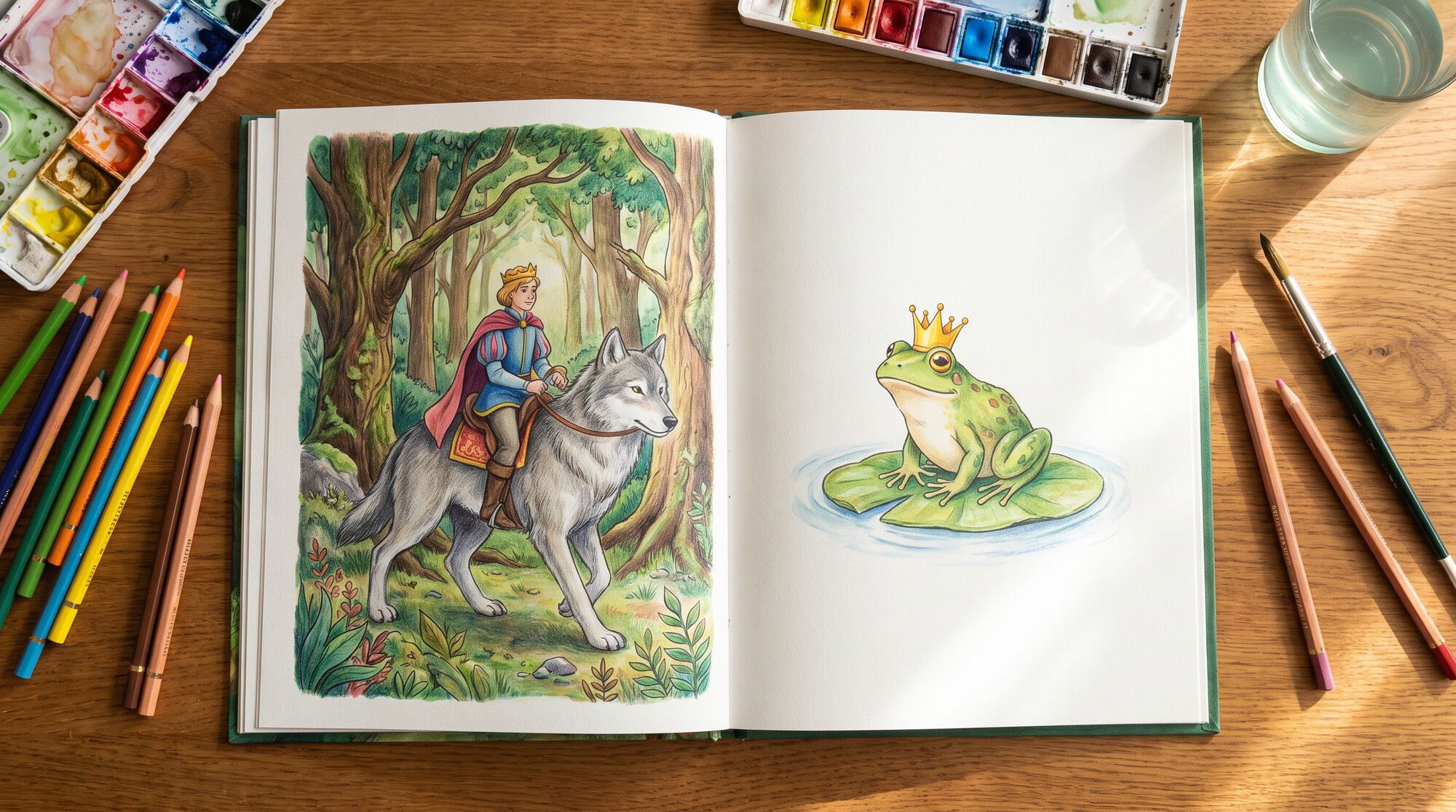
Illustrating a fairy tale is a common assignment in reading and art class. Everyone knows the story, yet the sheet stays blank: which moment to choose, where to put the characters, what to draw with. Below are a step-by-step plan, five examples for tales that come up most often in Russian schools, and a line drawing to copy. The examples were made in the AI2Face generator with Nano Banana Pro — use them as references for composition and color.
What a fairy tale illustration is
An illustration is a picture of a specific moment in the text. A good one answers three questions:
| Question | How the picture answers it |
|---|---|
| Who are the characters? | recognizable details: the frog’s crown, the prince’s red kaftan, the grey wolf |
| What’s happening? | one moment of action: the arrow has landed in the marsh, the wolf races through the forest |
| What’s the mood? | color and light: a dark forest feels mysterious, a bright morning feels joyful, a stormy sea feels tense |
If someone can recognize the story without a caption, the illustration works.
Fairy tale illustration: The Frog Princess
The best-known scene: Prince Ivan finds his arrow in the marsh next to a frog. For this example we chose the style of early 20th-century Russian book graphics: flat colors, crisp outlines and an ornamental border.
Book illustration for the Russian folk tale The Frog Princess, in the style
of early 20th-century Russian decorative book graphics: a small green frog
wearing a tiny golden crown sits on a lily pad in a marsh holding an arrow
in its mouth, a young prince in a red kaftan and fur hat with a bow kneels
on the bank and looks at the frog with surprise, birch trees and reeds,
flat decorative colors with fine black outlines, an ornamental folk-pattern
border frame around the picture. No text, no letters, no signatures.
The model put the arrow next to the frog rather than in its mouth, as asked — not a problem for an illustration, since the scene is still recognizable. Here’s the same picture as a line drawing, for anyone who wants to copy or color it:
Ivan Tsarevich and the Grey Wolf
The key image of this tale is the prince riding the grey wolf. We added the Firebird in a cage: its light glows through the night forest and instantly tells you which story this is.
The dark forest with mushrooms and a crescent moon feels mysterious, while the Firebird’s warm light picks out the hero. The same trick — a bright spot on the main character — works in a child’s drawing too: color the background darker and keep the hero bright.
Pushkin’s The Tale of the Fisherman and the Fish
In Pushkin’s tale the main scene repeats five times: the old man goes to the sea and calls the fish, and each time the sea is rougher. We painted a stormy sea — so this is one of the old woman’s last demands. On the shore stand the hut and the broken washtub.
The color of the sea is part of the plot here. If you’re illustrating the first request, paint a calm blue sea; for the last one, make it dark with white crests.
A folk tale drawing for younger kids: Teremok
In the lower grades, illustrations are drawn in colored pencils. Here’s what a child’s piece might look like for Teremok, the tale of animals sharing a little wooden house: the house, a mouse in the window, animals at the door and a bear that’s about to break it all.
The bear is the biggest figure and is walking toward the house — that’s how the drawing shows the story’s tensest moment. In the first version the model wrote a word on the house in Latin letters, even though we asked for no text; a separate command — “Remove the sign … Keep everything else exactly the same” — removed it.
How to draw a fairy tale illustration: 7 steps
- Reread the story and note 2–3 of its most vivid moments.
- Pick one scene — the one people can name the story from without a caption.
- Decide who’s the main character. Draw them larger and closer, the others smaller and farther away.
- Sketch lightly in pencil, without pressing: big shapes first, details later.
- Add details from the text: the crown, the arrow, the kaftan, the Firebird, the washtub.
- Pick colors for the mood: a dark forest for mystery, bright sun for celebration, a grey sea for tension.
- Outline and color. Keep the background simpler and lighter, the hero brighter.
Which scene to choose: ideas for popular tales
| Tale | Recognizable scene |
|---|---|
| The Frog Princess | the frog with the arrow in the marsh; Vasilisa waves her sleeve and a lake with swans appears |
| Ivan Tsarevich and the Grey Wolf | the prince on the grey wolf; the Firebird in the garden |
| The Tale of the Fisherman and the Fish | the old man calling the fish by the sea; the old woman by the broken washtub |
| Teremok | the animals at the little house; the bear sitting on the roof |
| Kolobok | the round bun singing to the fox on a tree stump |
| Morozko | the stepdaughter under a fir tree in the winter forest, with Father Frost beside her |
| The Magic Swan Geese | the girl and her little brother hiding under an apple tree from the geese |
How to make a fairy tale illustration with AI
AI is handy for quickly seeing composition and color options before drawing your own version. The prompt formula: the tale and the scene + the characters and their details + the setting and time + the technique (“watercolor”, “gouache”, “child’s colored-pencil drawing”) + “No text”.
Watercolor children's book illustration for the Russian folk tale Ivan
Tsarevich and the Grey Wolf: a young prince in a red kaftan rides on the back
of a huge grey wolf racing through a dark fairy-tale forest at night, a
glowing firebird in a golden cage in his hands lights the way, soft
watercolor washes, gentle ink lines, magical atmosphere. No text, no
letters, no signatures.
Always include “No text” — and still check the result: on Teremok the model drew a word anyway. To turn your own pencil sketch into a colored illustration, see the sketch to image guide; to animate a finished illustration into a cartoon, see the AI cartoon generator guide.
Bottom line
A fairy tale illustration works when it shows one recognizable scene, the main character is larger than the rest, and the colors carry the mood. Pick a moment from the table, sketch it in seven steps and color it in whatever technique suits you — pencils, gouache or watercolor. The examples and the line drawing in this article make good references, and AI can help you find a composition. Fairy tale illustrations are made in the AI2Face generator, with the cost shown before each run.
FAQ
How do I draw a fairy tale illustration?
Pick one vivid scene, decide which character is the main one and where they'll stand, make a light pencil sketch, then outline and color it. Draw the main character larger and closer and keep the background simpler. Add details from the text: an arrow, a crown, a hut.
Which scene from a fairy tale should I draw?
The most recognizable moment — one people can name the story from without a caption: the frog with the arrow, the prince on the grey wolf, the golden fish by the boat. One scene with two or three characters beats the whole story on one sheet.
Can I copy an illustration?
Yes, for practice. This article includes a line drawing of The Frog Princess: print it, trace it or color it. For a class assignment, bring your own drawing — the teacher grades your work, not a copy.
What technique should I use?
In school it's usually colored pencils, gouache or watercolor. Pencils are easiest for small details, gouache gives bright solid colors, and watercolor adds a soft, magical feel.
Can I make a fairy tale illustration with AI?
Yes: describe the scene, the characters, the technique and the mood. AI is handy for getting a reference and a composition idea, but draw your own picture for class.
Sources
2
- https://blog.google/innovation-and-ai/products/nano-banana-pro/
- https://ai.google.dev/gemini-api/docs/image-generation