
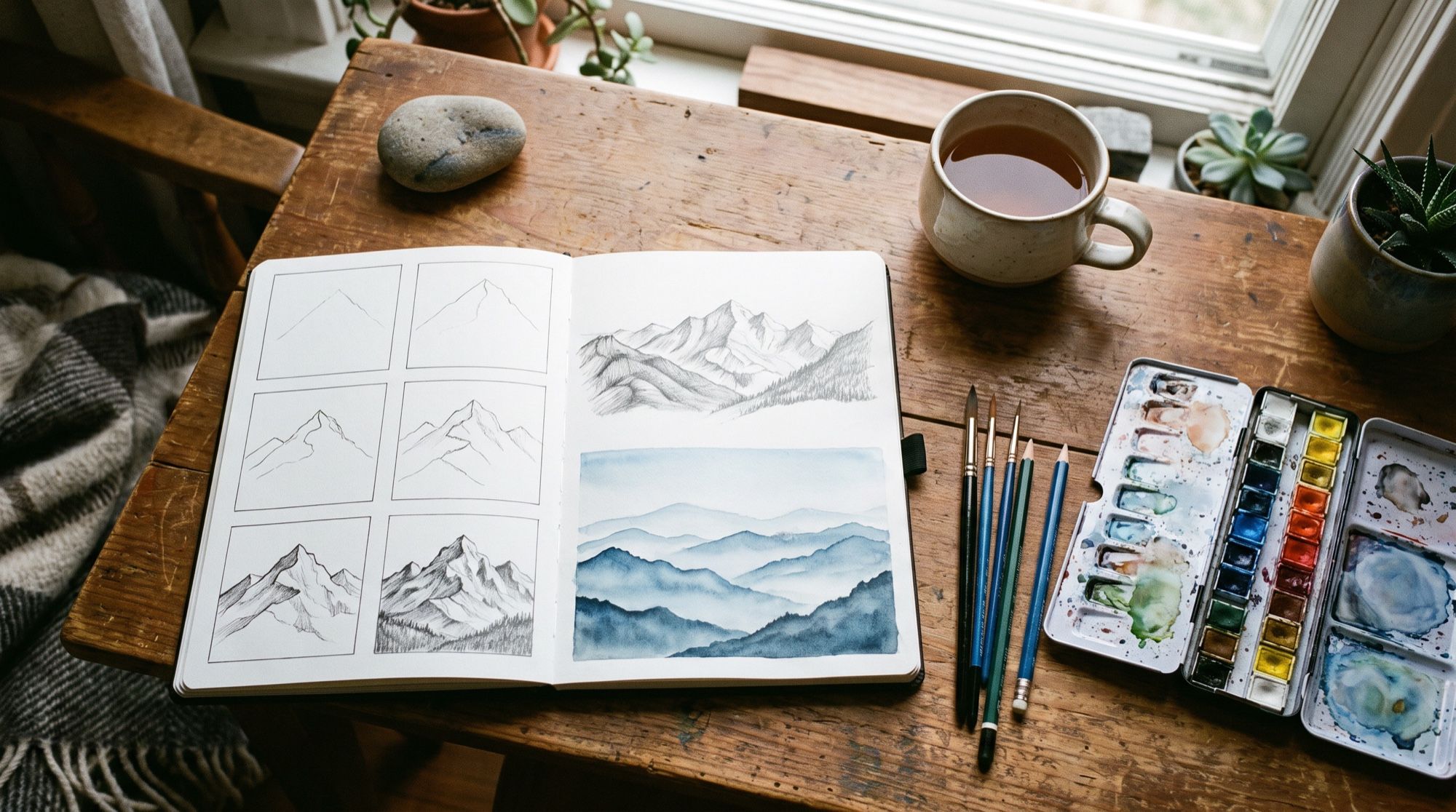
Mountains are a classic art-class subject and the first landscape for beginners: they’re built from simple triangles, and a single shadow gives them volume. Below are a 6-step tutorial, five techniques from a kid’s drawing to watercolor and a table of common mistakes. The tutorials and samples were made in the AI2Face generator with Nano Banana Pro; the new lines in each step are highlighted in red.
How to draw mountains step by step: 6 steps
- Horizon. A horizontal line in the lower third of the page. The mountains stand on it.
- Peaks. A jagged line of three peaks of different heights: the middle one is the tallest, and the slopes are of unequal length.
- Snow. A zigzag under each peak. Above the zigzag is snow, below it is rock.
- Hills. Two or three rounded waves in front of the mountains. They hide the bases and add depth.
- Trees and sun. A row of little fir trees at the bottom and a sun in an empty corner of the sky.
- Color. Blue-purple mountains with one side of each darker. White snow, green hills, a blue sky.
The dark side must be on the same side for every mountain — the side facing away from the sun.
Easy mountain drawing for kids
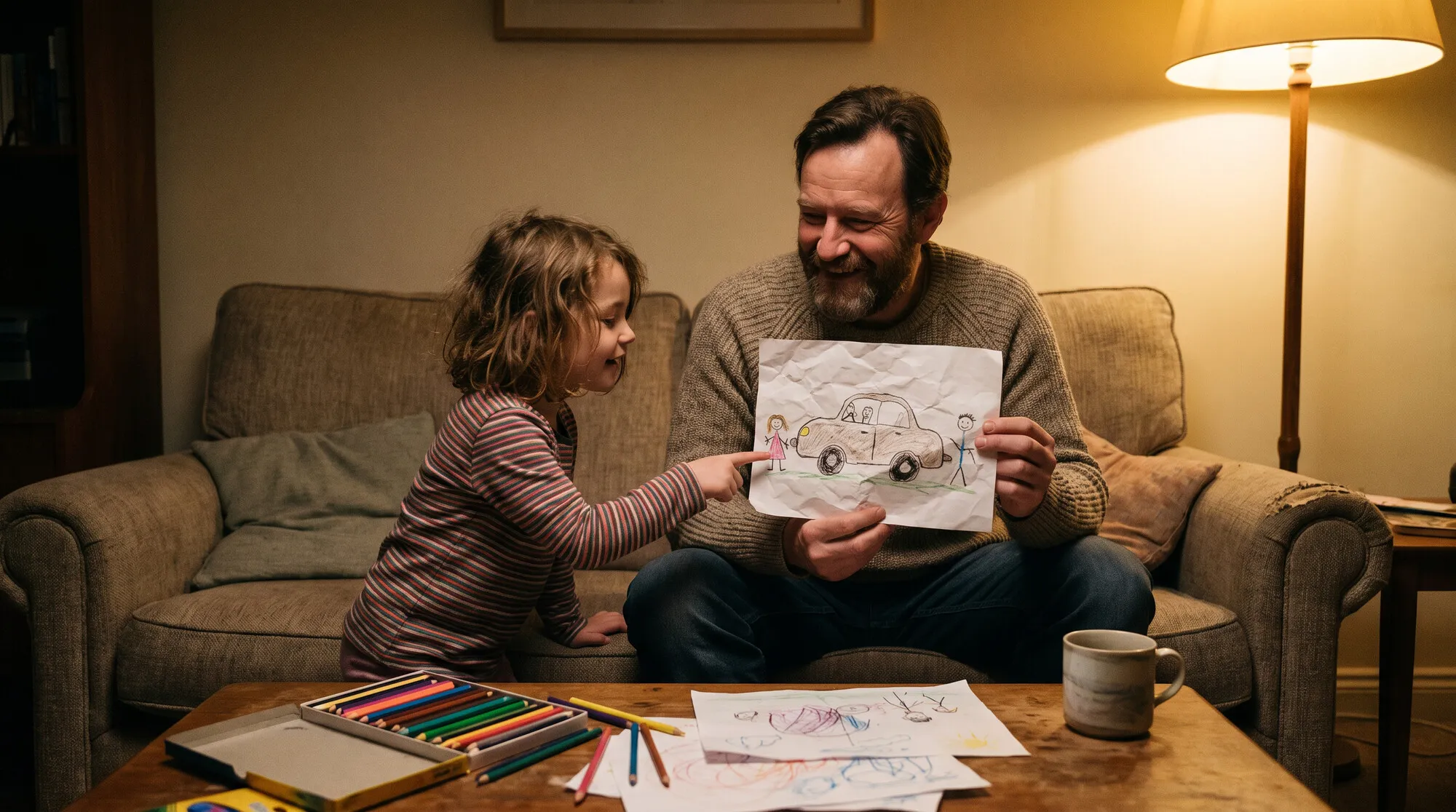
Kids aged 5–7 don’t need atmosphere or perspective — they need recognizable mountains: triangles with white tops. Here’s what a felt-tip drawing by a seven-year-old looks like:
Suggest two things: mountains of different heights and white snow on top. A river from the foot of the mountains, fir trees, a house and a sun turn three triangles into a landscape — “mountains and a river” is a common art-class assignment.
Mountain pencil drawing
In a pencil drawing, mountains rely on the contrast between light and shadow. Rock detail is only needed on the nearest peaks.
- Outline. A light jagged line for the range. From each peak, draw a ridge line down: it splits the mountain into light and shadow.
- Light. Decide where the light comes from. Barely touch the lit side.
- Shadow. Hatch the shadow side densely, with strokes following the slope from top to bottom.
- Rocks. Dark cracks and ledges on the near mountains, just a silhouette on the distant ones.
- Foreground. Fir trees or rocks at the bottom are the darkest spots in the drawing.
Use two pencils: HB for the outline and distant mountains, 2B–4B for the shadows and the foreground.
How to paint mountains in gouache: a landscape with a lake
Mountains with a lake are one of the most striking scenes: the reflection doubles the picture. Gouache is handy because light snow goes on top of dark rock.
- Sky. Deep blue at the top, lighter toward the horizon.
- Mountains. Gray-blue silhouettes with darker shadow slopes.
- Snow. White along the tops and on the lit slopes.
- Slopes and forest. Green at the base, fir trees in dark strokes.
- Lake. Repeat the mountains with the peaks pointing down, a little darker and without small details. A couple of light horizontal strokes make the water shine.
The same trick works with a river: it runs away from the viewer toward the mountains and narrows in the distance.
Watercolor mountains: mist and three planes
Watercolor conveys atmosphere best: misty mountains are painted in layers, from the farthest to the nearest.
- Sky. A light wash — peach or blue. Let it dry.
- Farthest ridge. Very light blue, with a crisp top edge and the bottom softened with clean water: that’s the mist.
- Next ridges. Each one darker and more saturated than the last, with a softened bottom too.
- Nearest ridge. The darkest, with a crisp edge; you can add fir tree silhouettes.
This is atmospheric perspective: the farther the mountain, the lighter, bluer and softer it is. In watercolor, snow isn’t painted in white — you leave the white paper. The same trick with fir trees is in how to draw a Christmas tree, and forests and leafy trees are in how to draw a tree.
Young vs old mountains: drawing the Caucasus and the Urals
Young, sharp mountain ranges and old, worn-down ones look completely different, and the difference shows at a glance. Two Russian ranges are a textbook example.
| What to draw | Caucasus Mountains | Ural Mountains |
|---|---|---|
| Height | high, peaks above the clouds | low ridges |
| Shape | sharp peaks, steep cliffs | gentle, rounded slopes |
| Snow | snow caps and glaciers year-round | no snow in summer |
| Slopes | alpine meadows, forest lower down | continuous taiga |
| Details | cliffs, gorges, mountain rivers | rocky outcrops on the tops |
The Caucasus are young mountains, which is why the peaks are sharp. The Urals are among the oldest mountains in Russia: over millions of years they’ve worn down, so draw them as soft waves rather than triangles.
Common mistakes when drawing mountains
| Mistake | How to fix it |
|---|---|
| A fence of identical triangles | peaks of different heights, slopes of unequal length |
| Flat mountains | one side of each mountain is darker — the same side for all |
| Snow drawn as a straight line | the snow line is a zigzag, lower in the gullies |
| Distant mountains as bright as near ones | the farther, the lighter and bluer |
| Bases floating in the air | hide them behind hills, forest or mist |
| A lake reflection brighter than the mountains | the reflection is darker and without small details |
How to make your own drawing tutorial with AI
Need a tutorial for a different scene — mountains at sunset, a volcano, a mountain lake? Describe it to the AI: a grid of numbered panels + what gets added in each step + “only the newly added lines are red” + “Only the digits, no other text.”
Step-by-step drawing tutorial on how to draw mountains, a clean grid
of exactly six equal panels in two rows of three, each with a big
digit 1 to 6 in its top left corner. Panel 1: a horizon line in the
lower third. Panel 2: a jagged outline of three peaks of different
heights, the middle one tallest. Panel 3: zigzag snow caps. Panel 4:
rounded hills in front. Panel 5: small fir trees and a sun. Panel 6:
the finished landscape colored, with shading on one side of each
mountain. In every panel only the newly added lines are red and
earlier lines are black. Only the digits 1 to 6, no other text.
Check the small details: in our tutorial, a stray red stroke was left next to the right peak in step 3. The AI can also redraw your own mountain photo in any style — see our guide to turning a photo into a drawing.
Bottom line
How to draw mountains: a horizon, three peaks of different heights, zigzag snow and shadow on one side. Kids only need triangles with a river and fir trees; in pencil, the key is the contrast of light and shadow; in gouache, try mountains reflected in a lake; in watercolor, layers of misty ridges. Draw young mountains like the Caucasus as sharp snowy peaks and old ones like the Urals as gentle forested waves. You can make drawing tutorials on any topic in the AI2Face generator — the cost is shown before you generate.
FAQ
How do I draw mountains the easy way?
Draw a horizon line in the lower third of the page and a jagged line of three peaks of different heights above it. Add a zigzag of snow under each peak and rounded hills and little fir trees in front. Shade one side of each mountain darker to give it volume.
How do I draw mountains in pencil?
Sketch the outline of the range and decide where the light comes from. Leave the lit side almost white, shade the shadow side densely with strokes following the slope. Draw distant mountains lighter and without detail.
How do I paint mountains?
Start with the sky, then paint distant mountains in light blue and near ones dark and saturated. In gouache, add snow on the peaks in white at the end; in watercolor, leave the white paper. A lake repeats the mountains upside down.
How do I draw mountains with a child?
For a child aged 5–7, three triangles of different heights with white zigzag snow on top are enough. Add a sun, a river from the foot of the mountains, fir trees and a little house, and you have a finished landscape.
How do young and old mountains differ in a drawing?
Young mountains like the Caucasus have tall, sharp peaks with cliffs, glaciers and snow above green meadows. Old mountains like the Urals are low ridges with gentle rounded slopes covered in taiga, with a few rocky outcrops and no snow caps in summer.
Sources
2
- https://blog.google/innovation-and-ai/products/nano-banana-pro/
- https://ai.google.dev/gemini-api/docs/image-generation